

What we learned when we started our own dancefloor
We haven't yet achieved "magical" status, but we're working on it

Over the last year, I’ve submerged myself into dancefloors in a way that I never dreamed might be possible. In 2025, with the help of my lovely partner, I built a dancefloor on my rooftop — from DJ decks to soundsystem to lighting — and hosted 10 events on it, booking 37 DJs to play as the sun set on Southern California.
I was inspired to do this by two books in particular. The first of them told the story of Tony Pike, the playboy who sunk a boat in an act of insurance fraud in order to turn property on Ibiza into one of the Island’s best dancefloors:
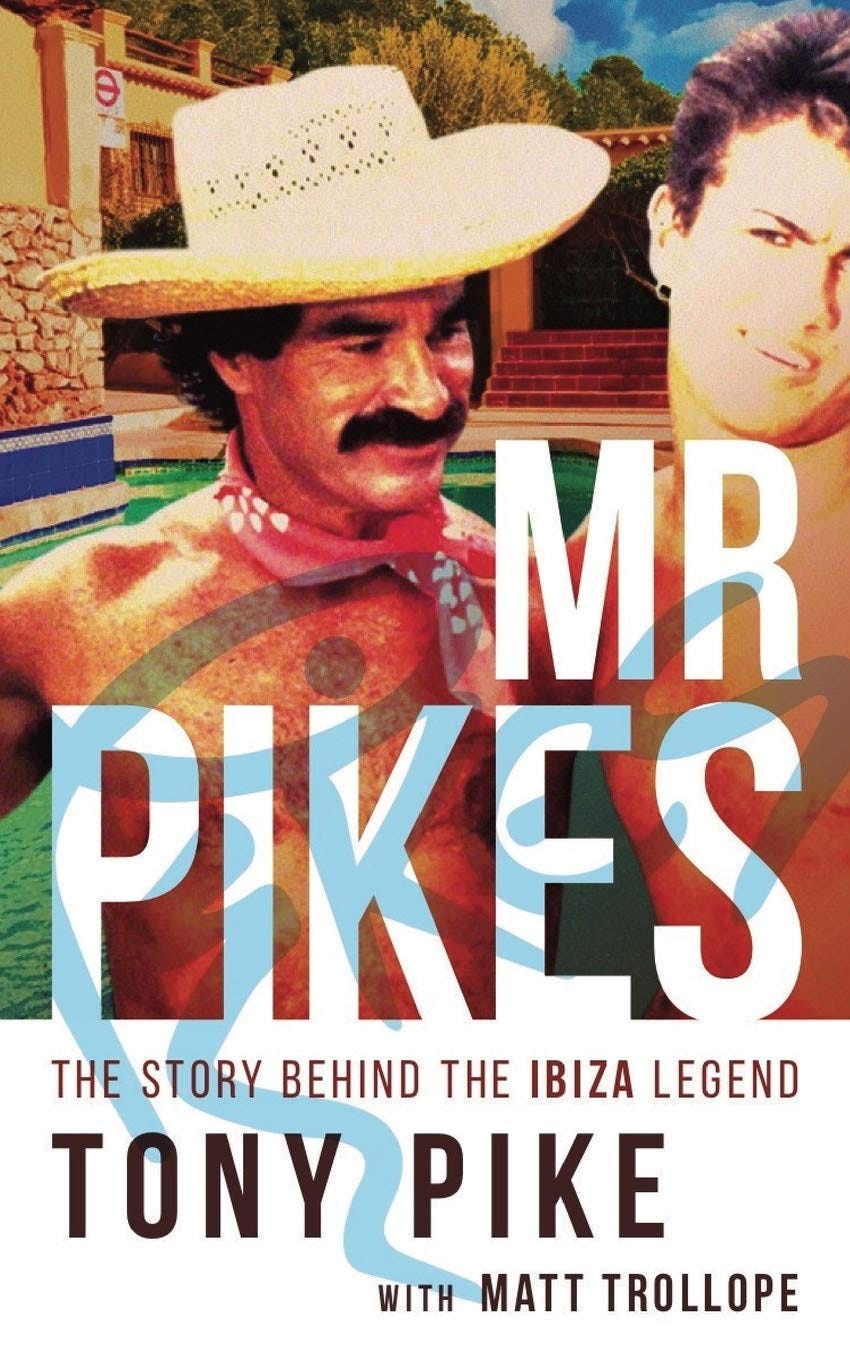
I wouldn’t recommend the book. As with most autobiographies, this one isn’t honest enough to earn top ratings. You’d think that the author’s admitting to insurance fraud, drug dealing, and unprotected sex while HIV positive might be the sort of honesty that I’m looking for, but I never got a feel for who Tony Pike really was. He was a playboy, yes, and so charismatic that he (by his own count) slept with 3,000 women and at least two men including George Michael, but his charisma didn’t make the pages of the book.
But despite its failure as an autobiography, a detail stuck with me, and that was how Tony stubbornly took a pickaxe and jackhammer to carve a party palace out of Ibiza’s bedrock. His effort to will a party into existence made me want to do the same, and though I read the book as research for a trip we were planning to Ibiza, it ended up convincing me that I could make something happen, even if I had to take up a pickaxe to do it.
The second book:
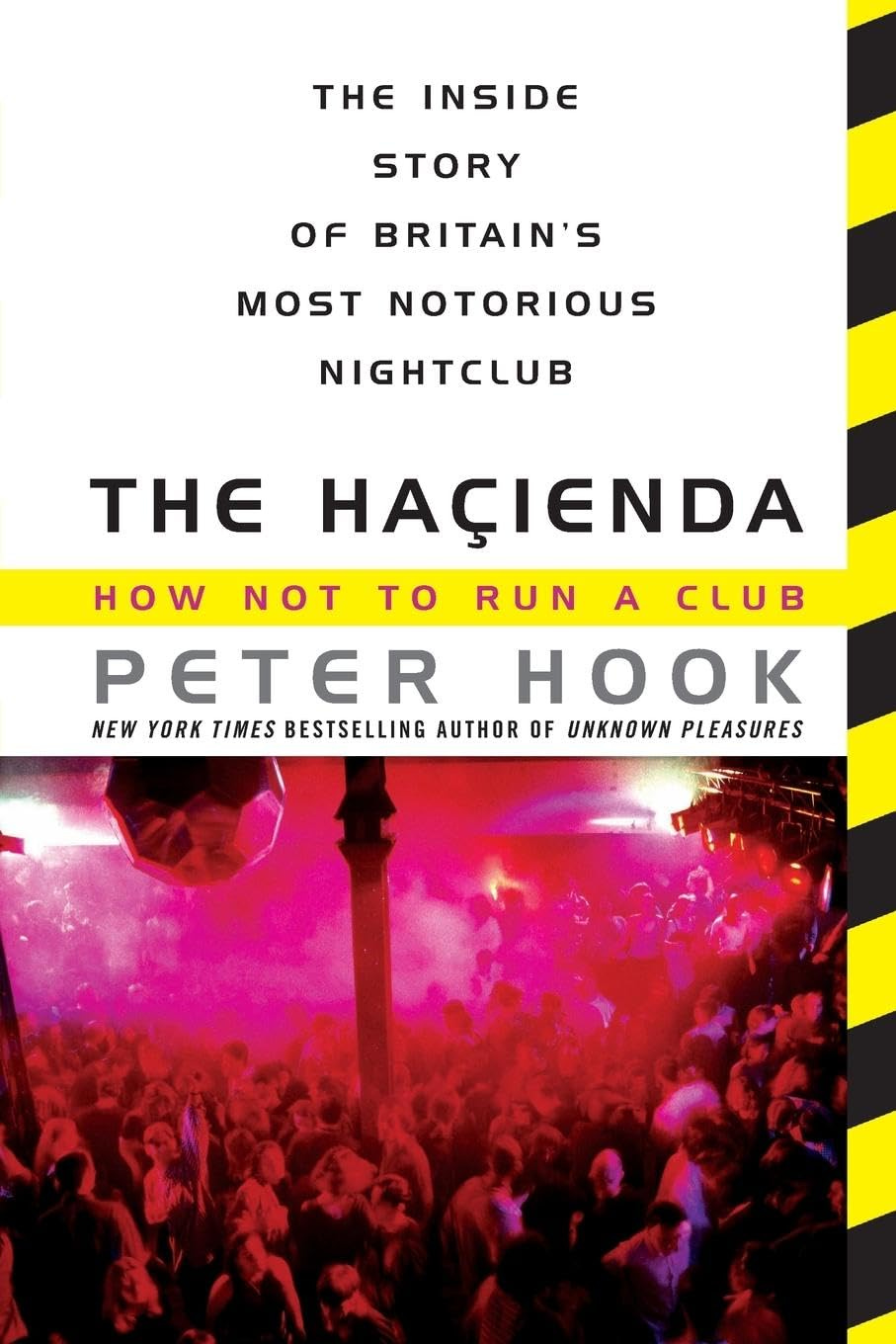
This first-hand history, written by one of the principals involved in legendary nightclub The Hacienda, delivered a fat rail of eye-opening inside dope directly to my brain. The problem is (to extend and torture this druggy metaphor), a lot of the dope isn’t clean, is cut with who knows what, and is delivered by an unreliable dealer who is so high on his own supply that the reader can never be certain whether they’re getting an ecstasy-tinted bowdlerization, an LSD-fueled hallucination, or a booze-soaked reconstruction of snippets stitched together between blackouts.
I learned a lot about how clubs work, how not to manage the budget of one, and ultimately I decided that I would be nowhere as incompetent as the author or his friends as I shaped the plans for my own private club.
And so we opened our private, friends-only club in the late spring of 2025, announcing eight dates, then adding two more as the schedule came together. I wanted to battle-test my DPARTI framework against a real-world, soup-to-nuts dancefloor experience, and by that measure, we succeeded, attracting hundreds of dancers, dozens of DJs, and even just the right amount of notoriety as we danced our nights away.
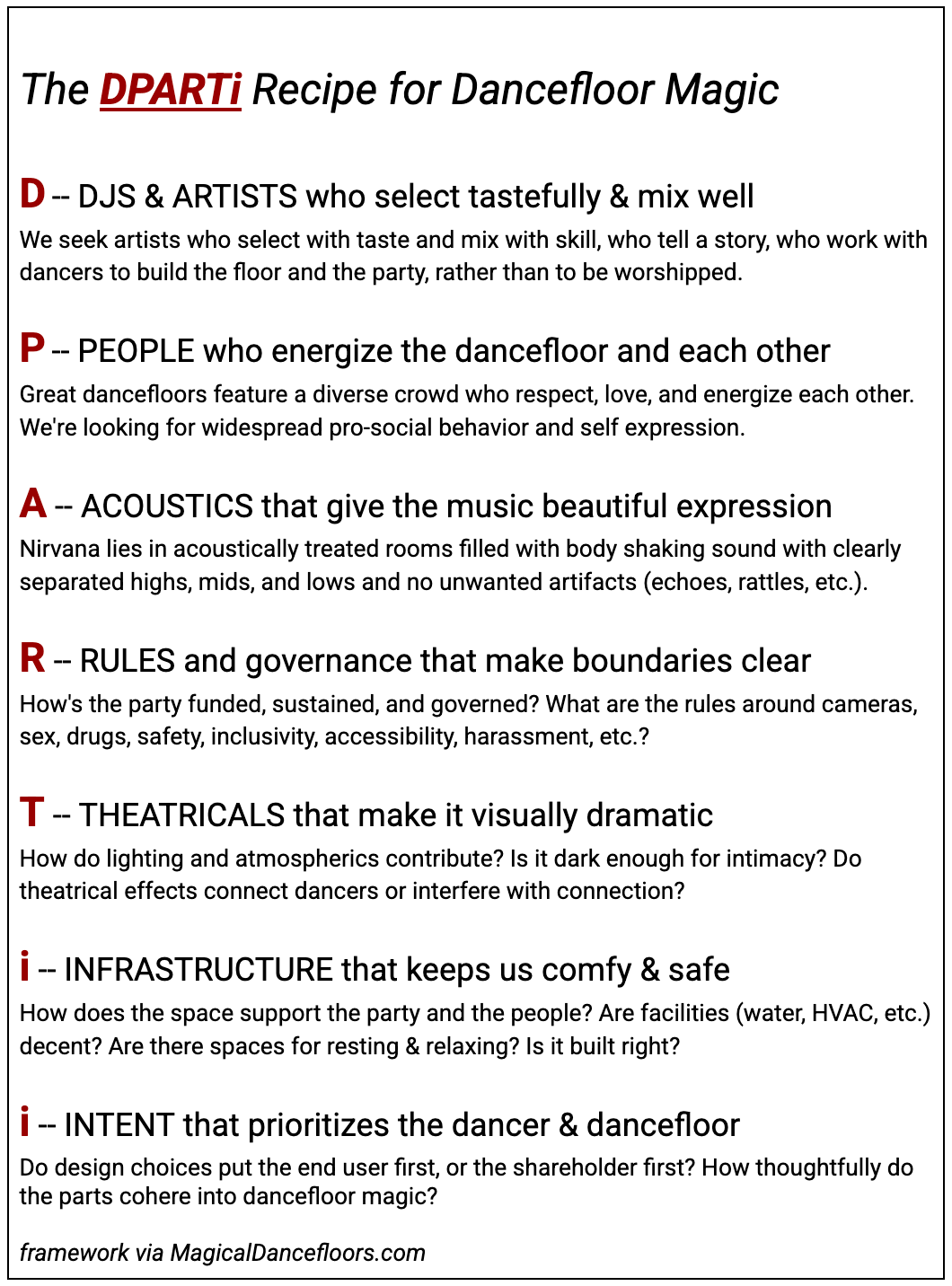
Perhaps my proudest accomplishment came in the form of how we defined our sound. We coined the term Calearic to describe our particular mix of the Balearic mother tree to which we grafted California elements and sounds.
Balearic itself isn’t an easy genre to pin down — here are some example definitions. They’re kind of all over the map:
“Balearic was a response to a moment in time. A rebellion against musical and political constraints,” Jaime [son of DJ Alfredo, the ‘father of Balearic beat’]. “Today, it’s less about escaping systems and more about emotional honesty. It’s still anti-hype, still genre-fluid, but now it speaks to a generation looking for meaning, connection and timeless music in a world of trends. It’s about not boxing yourself into one style, but allowing your full musical culture to come through by reading the room and responding to the energy of the moment. Balearic is also about diversity of people, of social classes. It’s the freedom to mix simple but powerful records, melancholic soundtracks or even countercultural music that captures a specific feeling. At its best, it’s poetic.”
“DJ’s [mixed] together musical forms as diverse as ‘Public Enemy’ and ‘The Woodentops’, to create that eclectic, highly danceable, don’t care holiday feel.” #
“Balearic is a mindset more than a rigid, definable sound. This church is a broad one, welcoming everyone from Status Quo to The Orb, Marvin Gaye to Dire Straits, the Cocteau Twins to Mike Francis.” #
“A hippie-dippie, candy-flipping fusion of synth pop, yacht rock, acid house, faux reggae, and ambient music…the best contemporary Balearic music also conveys a spirit of innocence, openness, and adventure.” #
“It’s not a genre,” insists Pete Gooding, a veteran soundtracker of Ibiza sunsets and noted Balearic compiler for Hostal La Torre Recordings. “It’s an open-minded approach to how and what you play. Being more eclectic is the point.” #
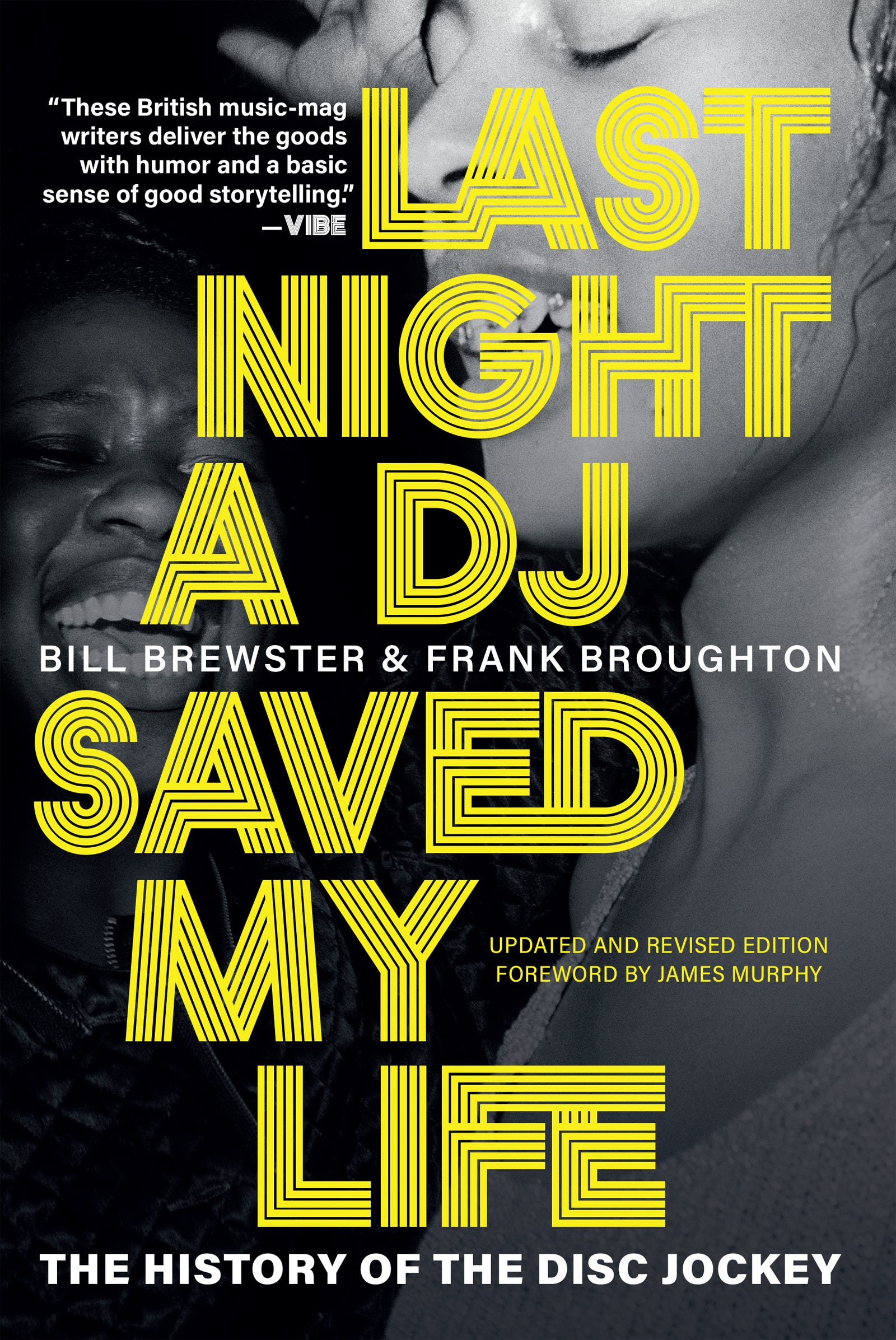
Perhaps the very best definition of the Balearic sound comes from the book “Last Night a DJ Saved My Life,” in which Balearic is defined as follows:
“When it became clear that the very foundations of house and techno were built with records from continental Europe, snobby British musos started reappraising Italian, German, Spanish, Dutch, even Belgian club history, re-evaluating the music these scenes prized and produced, and plundering them for unheard tracks. As well as inspiring such historical revision, by making lyrics largely irrelevant, house and techno further eroded the English-speaking world’s great pop-cultural advantage.
The Balearic spirit is a willingness to try anything in the service of your dancefloor. Forget music snobbery, an artist’s credibility is irrelevant. Forget the division of different genres, and the obsession with newness, you can even sometimes ignore the correct speed of a record. The established rules of DJing need not apply. All that matters is the power and beauty of each song in the context you place it.
Named after the Mediterranean archipelago which contains Ibiza, and originally referring to the music of Ibiza’s DJ Alfredo, ‘Balearic’ implies a musical openness, an anything-is-possible attitude. It was often born of necessity – the need to stretch a limited number of records to fill long summer nights – but it taught an important lesson to any DJ who treated music with too much reverence.
Balearic is ‘Flesh’ by A Split Second played at the wrong speed to turn it from gothic industrial to deep proto-house; it’s the indie guitar mash of The Woodentops energising glamorous queens in the open air at Amnesia; or trippy Klaus Schulze records washing over kids zonked out on heroin by the side of a gorgeous Italian lake. Balearic invokes the holiday defencelessness you get from warm sand between your toes and a horizon of sparkling waves.
Importantly, Balearic is an attitude to music more than a specific style or location. Or, as dance music writer Frank Tope quipped: ‘It’s pop music that sounds good on pills.’
Given the difficulty of nailing down a description of the sound, you can imagine that my attempts to book DJs to play to it were somewhat uneven. But we did succeed in attracting several accomplished DJs who did in fact nail the assignment. Here’s one of the sets I loved the most, played by DJ Joe Rodriguez, a SoCal legend whose Balearic, vinyl-only set set a high bar for all other DJs we booked in our first season.
This summer, we’re doing it again. We’ve got seven dates calendared from May through October, and we’ve improved and upgraded a number of elements over the winter season. There’s a new soundsystem, there’s an upgraded lighting rig with custom-designed DMX sequences, there’s a refined calendar, there’s a better sense of our sound and style, and we’re heading into the season with a mailing list of a few hundred friends rather than starting from scratch.
I will confess that our dancefloor isn’t magical yet. I’d give us a 6 or 7 on my 10-point scale. Our shortfalls are numerous. Using the DPARTi framework, our shortfalls are especially pronounced in three areas:
(1) PEOPLE: Though we’ve been graced by many awesome, kind, and friendly people who treat each other well, look out for each other, and who often volunteer to make the party happen. This is no shade on the friends who are showing up and who co-produce the event with us. But we haven’t yet reached critical mass of people who dance their hearts out. I can count on one hand the number of folks who really lit up the dancefloor in our first seasons (Gerardo was the star of season one). If we can find a dozen more folks like Gerardo, magic will happen with regularity.
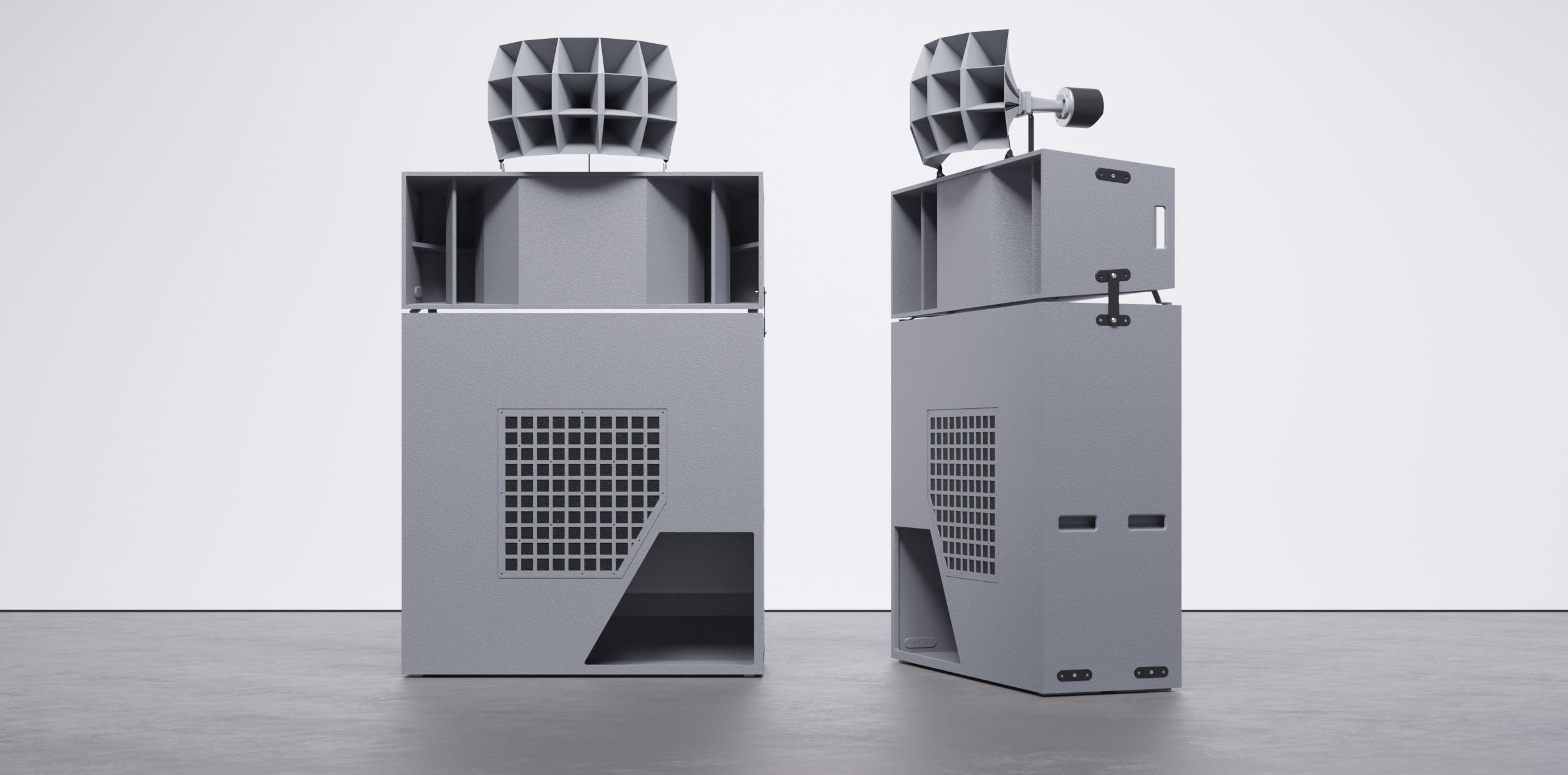
(2) ACOUSTICS: I have champagne tastes and a Pabst budget. My soundsystem, from the Technics 1200 turntables connected to the DJM V10 mixer to the BassBoss Sublim8 three-way speaker columns isn’t shabby, but it’s no McIntosh-powered Despacio, nor d&b audiotechnik (Signal NYC) nor PK Sound (Shambhala) nor Void (Pikes) nor NNNN Audio (Public Records) nor even Funktion One (Berghain). One day I hope to have a spare six digits to spend on a soundsystem, but until then our system is in the mid five figures. Not shabby, but not anywhere near world-class.
(3) THEATRICALS: On the one hand, nothing beats mother nature’s light show. Sunsets in Southern California can’t be beat. On the other hand, once deep night arrives, our own lighting rig needs to carry more of the load. We’re still climbing the learning curve on that front. The addition of some Martin fixtures and a disco ball should result in a much-improved theatrical experience for season 2.
Want to attend? If you find yourself in Southern California this summer and would like to join our events, join the mailing list via website Badcat.fm. And if you’re a paid subscriber, shoot me an email to be added to the guest list for you and your plus one.
I know you’re in LA - I just moved to NYC and have been wanting to go dancing, do you have any recs of places in New York??
This is so interesting to stumble across my feed on substack! Love this niche passion and love that you’re writing about it! Thank you!!!